

A Non-review by Professor Popinjay
(2013)
When I started watching this, I couldn’t imagine why I had missed it. I speculated maybe I deemed it as not my cup of tea. I’m sure it’s well established here, I’m not a fan of certain types of horror. I must have decided this was in that same group.
Eventually I realized this came out in 2013. No wonder I missed it! I was deep within the confines of a marriage to an iconoclastic paranoid schizophrenic. Not blaming her for anything. Mental illness was not her fault. She’s a human, not a zombie. It just happened to result in me not getting to see movies very easily for a ten year stretch. I’m still playing catch-up.
Warm Bodies, believe it or not, is Romeo and Juliet with zombies… even down to a balcony scene. But it’s so much more than that.


Pride and Prejudice and Zombies was a kind of toungue-in-cheek novelty played for laughs. The absurd mixture of romance with zombie horror action in a regency era setting didn’t take itself too seriously and didn’t expect the audience to either. Warm Bodies on the other hand, while still presented with copious doses of humor, has a profound underlying message not even found in the original Romeo and Juliet.
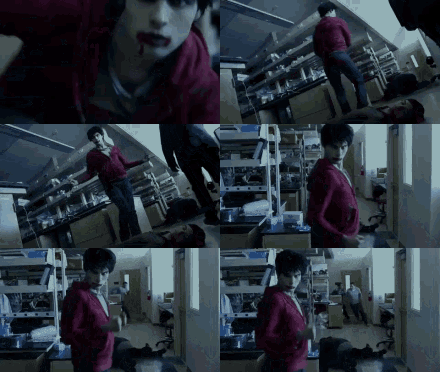
There’s more going on than just boy likes girl, or in this case, zombie boy likes living girl. That premise alone provokes rather disturbing imagery. But this is not a story of a dead thing loving a live girl nor is it a story of a live girl loving a dead thing. This is the story of a girl realizing these things they titled “corpses” are just infirmed and enfeebled… and as a result just happen to eat brains but that’s beside the point.

It’s a story of one of the so-called corpses realizing they still have a spark of life left and that it can grow and heal with simple human connection. This revelation eventually extends to the other “zombies” as well. In a Shakespearean tragedy where everyone starts out dead, so-to-speak, what ultimately transpires is beautiful.

I loved the very brief but poignant scene where Julie is explaining to her friend that “corpse” is just a title that we’ve applied to these ill people and with that title comes all kinds of assumptions.

Optional Tangent:
Sadly, I happen to know people who shamble around town, plagued by horrific visions. They are terrified of anyone who would seek to help them. They go in and out of jail, treated like a criminal or worse. They are incapable of helping themselves. There’s nothing humane about their situation nor is there anything humane about the system to which they are subjected. I’m not comparing them to zombies.
In fact, I’m un-comparing them. Thankfully, there are professionals who recognize this inhumane cycle and are working to help those who cannot help themselves. These same professionals also seek to maintain accountability and respect where administering necessary help might inflict on a person’s agency. But the progress is slow going and far from achieved.
Oddly, while we may find it easy to recognize a severely mentally ill person as still human, sadly we apply all manner of titles to arguably rational people in an attempt to de-humanize those who do not coincide with our own beliefs or standards of living. And yet, those people (not gnomes!), even the ones titling and dehumanizing us right back, are precious and worthy of love. Some may never come around to see our own value but that is no excuse to stop valuing them. We cannot fight fire with fire.
There is another element in the narrative of Warm Bodies: that of the “Boneys” or “skeketons”. Though I hesitate to label even them for fear of invalidating my point. The “boneys” are “zombies” who are so far gone that they basically start dehumanizing themselves, if you’ll permit me to describe them at least by the allegory I detected. Personally, I think these more accurately represent the conflict between the Capulets and Montagues but there I go dehumanizing things again.
The dangerous thing to assume in real life is that we might have the ability to detect when some human is indeed so far gone they’re not saveable from their own lack of self worth or even their apparent inability to value others. But we must never think we have this ability because too often we can only judge by what we see on the outside, too often we decide we see a monster because we don’t understand what they’ve come from. We must regard everyone as reachable regardless of these assumptions, even while they try to eat us.
I must believe everyone is human and valuable because my own value has been afforded to me. If I cannot extend such a gift to others, I am not worthy of it myself. And to be unworthy of that gift, to me, is the same as being dead… even while I shamble around.
Happy Halloween.
 Professor Popinjay's Compendium of Perspicacity
Leave a comment